Please note that this transcript was auto-generated by the video hosting technology platform used. We cannot guarantee its accuracy.
Welcome & Introduction
Ben Hall: Well, great. Let's get started. Really appreciate everyone taking the time to be here tonight. My name is Ben Hall, and I'm the CEO of Sunday Health, and we're really excited to have you here this evening for a discussion about cognitive health and staying sharp as we age, and the steps that we can all take to stay sharp as we get older. We all want to live our best lives, and we're very lucky to have some experts here to talk about that this evening, so thank you for attending.
And I'm honored to be here with Dr. Amy Sanders. She's a neurologist specializing in dementia and cognitive decline, and someone who's dedicated her entire career to staying on top of all the latest trends and research that are going on in the field. So Amy has some great content, and then will be around to answer some questions. Really appreciate her being here.
In terms of format, we'll plan to walk through some content for the first part. That'll go on for about 30 or 40 minutes, and then we want to make sure we leave about 20 minutes for Q&A. We appreciate all the questions we've gotten ahead of time. We'll try to actually address some of those questions during the content, and then we'll open it up for some live Q&A if folks have questions.
About Sunday Health
Ben Hall: Sunday Health is a virtual specialty neurology clinic that's really focused on prevention, diagnostics, and ongoing care around cognitive health, all for the goal of helping people stay sharp, understand their baseline, and, to the extent there is anything to be worried about, help them understand where they're at and what their options for care are.
The things we really focus on at Sunday Health are making sure people get seen quickly and talk to a team of experts very quickly. Often we can speak to you the same day and get you set up with our clinical team within one or two weeks. We're very proactive, as you'll hear from Dr. Sanders, about how we approach making changes in our lives and introducing new therapeutics and preventative strategies.
And we're holistic, so we really look at the whole person: your clinical history, your family history, your motivations as you age. We really try to see you as a whole person, but also deliver very whole-person-focused care.
We also have what's called a longitudinal model, so we don't just give you information and then go away. We really stay with you as a partner through your journey, whether you're here tonight, or if you decide to speak with us in the future just to get a baseline and gain information, or if there are things you actually have concerns about or want to seek care for. We are your full care team, a one-stop shop for resources and expertise in the cognitive health space.
So I'll hand it over to Dr. Sanders, and she's got some content that she'll go through. Really excited to hear from her tonight.
What We Mean by Cognition
Dr. Amy Sanders: Thanks, Ben, and welcome, everyone. Thank you for showing up to help yourselves be proactive in taking the best possible care of your own brains.
One word that we're going to use quite a bit this evening is cognition. Cognition, simply put, means thinking. And when I, as a cognitive neurologist, think about thinking, I actually slice and dice it into what we call domains, or areas of thinking.
Many of you are probably aware that memory is a very important domain of thinking. But we also pay attention to a person's ability to pay attention, to reason, to use language, and to interpret visual and spatial information. Sometimes we delve into one or more of those categories a little bit more than the others, depending on the issues or concerns that a person brings to us. But the general understanding of cognition is that it is made up of multiple domains, including attention, memory, language, reasoning ability, and interpretation of visual and spatial information.
Normal Cognitive Aging
Dr. Amy Sanders: Most of us are going to get older, and as we get older, we are going to notice the slings and arrows of aging, not only as they affect the color of our hair, or the wrinkles in our skin, or the way that our knees or hips or perhaps lower back bark at us on a daily basis. Most of us will also notice that things begin to change as we get older in terms of our thinking.
There are a few lucky people who will have what we call optimal cognitive aging. They don't notice much in the way of changes, but they are the exception, not the rule. Most people undergo what we call typical, or normal, cognitive aging. Our cognitive processing slows down. We don't think quite as quickly, we don't react quite as quickly when we're in our mid-60s or 70s or 80s as we did when we were in our 20s, 30s, and 40s.
A few words about what is normal for cognitive aging. Paying attention often requires more focused and active effort. When I was in my 20s, I paid attention to things without giving it a second thought. Now that I'm in my mid-60s, I find that sometimes, and this is especially the case if I'm tired, I have to make a conscious effort to invoke my ability to pay attention. And when I do that, things go more smoothly than if I don't. So that's a common feature of normal cognitive aging, that attention is no longer as automatic as it once felt.
Multitasking, or doing complex activities, often feels more difficult. Once upon a time, my example here was programming a VCR. That just shows you how old I am. That is related to this ability to pay attention.
These are all things that happen as part of normal cognitive aging. They are not indicative of emerging or concerning cognitive decline, or of somebody who's moving into the dementia state.
The Tip-of-the-Tongue Phenomenon
Dr. Amy Sanders: People may experience what I call the tip-of-the-tongue phenomenon, and what many people call, "Oh my god, is that the beginning of Alzheimer's disease?"
The tip-of-the-tongue phenomenon occurs when you are trying to remember the name of that restaurant, or the name of that actor, and you can't come up with it right away. The general rule is, if the thing that you couldn't remember in the moment that you needed it comes back to you later, after seconds, minutes, hours, days, weeks, months, or maybe even longer, then that is called the tip-of-the-tongue phenomenon. In one case, memorably for me, something I couldn't remember came to me six months later.
It is the characteristic aspect of normal cognitive aging.
When Changes Are No Longer Normal
Dr. Amy Sanders: Then we get into what is no longer normal for one's cognitive age, and we have here, really, a continuum.
Initially, if somebody begins to have objective cognitive impairment in one of those areas of thinking, meaning attention, memory, language, reasoning, or visual-spatial interpretation, and "objective" means you've had testing, and if there's objective evidence of decline in one area but you're still able to function in your life the way that you have typically and normally for you, we call that mild cognitive impairment. Mild cognitive impairment means there's objective evidence of cognitive decline, but there's no evidence of functional decline.
And then we can cross over into dementia: mild dementia, moderate dementia, severe dementia. Dementia means nothing more than that there's objective evidence of cognitive impairment, just as in mild cognitive impairment, but now there is also functional decline. That means you are no longer able to do the things for yourself and take care of yourself in the way that has been normal for you. Some people have trouble managing money, some people have trouble driving a car, some people might have trouble doing their food shopping every week, or they're leaving the stove on.
Any evidence of functional decline means that we have to consider whether a person is in one of the stages of dementia.
Dementia is not a disease. It's what we call a syndrome, a collection of symptoms. And in dementia, there are two symptoms. One is objective evidence of cognitive decline, and the other is evidence of functional decline. The latter often comes to us not from the patient him or herself, but from a care partner, someone who knows them well, often a family member.
Warning Signs Worth Evaluating
Dr. Amy Sanders: What isn't normal? If you find that you are asking the same person the same question over and over again. What time are Bob and Sally coming for dinner? And you ask that at 10 in the morning, and then at 11:15, and then again at 1:35, and you're posing the same question to the same person multiple times. That is not diagnostic of anything, but it can be a warning sign.
If your mood has become very fragile and labile, meaning that you're cycling between good and bad moods, if you're more irritable than usual, that can indicate that things are not normal. And if you're unusually anxious or unusually depressed, that is going to have an impact on the clarity of your thinking.
If you find that you can no longer follow a sequence of things, whether that's the steps needed to make a recipe, especially a recipe that once upon a time was easy for you, or if you struggle to follow the plot in a TV program or a book. Some TV programs just have incomprehensible plots, but if that is a problem occurring for you every time you try to watch a TV program, that can be an indication that maybe something is beginning to change.
If you get lost. Now, I used to drive on the roads in New Jersey, and I'm not casting aspersions on the state of New Jersey, but I will say that the signage on the roads is perhaps not as good as it could be, and I used to get lost regularly whenever I was in New Jersey. Was I concerned that that was an indication that I was beginning my own cognitive decline? Not so much, because I knew the particular context. But if you get lost in areas that should be familiar to you, the doctor's office that you've been going to for decades, the hairdresser or barber you've been visiting for maybe even longer, if you're getting lost in familiar areas, that can be a warning sign.
Why would that be a warning sign? It's because the same part of the brain that works on memory also works on what we call navigation.
The Alzheimer's Association lists 10 warning signs of dementia on its website, and I'm not going to go through each of these, but some of the things I've already mentioned. If you're misplacing things, if you are having trouble with spatial orientation, if your mood is changing, if you can't keep track of things, especially when there's more than one thing that you need to keep track of. These are all indicators that can be, not necessarily are, but can be an indication that it is time to get your cognition evaluated.
The Diseases That Cause Dementia
Dr. Amy Sanders: I mentioned earlier that dementia is just a syndrome. It means objective cognitive decline plus evidence of decline in a person's ability to function and take care of themselves. That's all dementia means.
So if somebody like me is going to say that somebody meets criteria for dementia, the next thing that I must do is say what disease I think is causing the dementia. Dementia itself is not a disease, but the conditions that I'm about to mention now are diseases, each of which can cause the dementia state.
The big kahuna here, the one that outstrips all of the others, is Alzheimer's disease. Alzheimer's disease probably accounts for some 60 to 70% of all of the cases of dementia that occur in the world.
There are changing epidemiological data about which is number two. Once upon a time, we would say that it was vascular dementia. Maybe it's also something called dementia with Lewy bodies. Dementia with Lewy bodies is what Robin Williams had, and many people are aware of it only because Robin Williams had it. This is a dementia that features early visual hallucinations that seem very, very vivid and real and can be quite frightening to people. It features early evidence of REM sleep behavior disorder, which means that you're acting out the content of your dreams. Dementia with Lewy bodies is probably the second most common dementia, and very frequently it overlaps with Alzheimer's disease.
Vascular cognitive impairment, or frank vascular dementia, is probably in third place. There's some argument about who's second and who's third. And very, very commonly, we see that there is an overlap between Alzheimer's disease and vascular disease causing cognitive impairment. Indeed, if I were to walk around on the streets and open up the heads of everybody who was 65 years or older, the most common neuropathological finding would be that of mixed disease, with Alzheimer's pathology plus vascular changes being the most common.
And then there are other diseases that also occur. Frontotemporal dementia is the fourth of what I consider to be the big four. That's what Bruce Willis has. Frontotemporal dementia is different from the rest of the dementing diseases, because it tends to affect people when they are in their late 50s, maybe, rather than their late 70s. And it comes in different varieties as well. There's a variety where behavior changes first, and then there are other varieties in which language changes first.
So those are the big four: Alzheimer's disease, by far the biggest; vascular dementia, or vascular cognitive impairment; dementia with Lewy bodies, with early hallucinations and dream enactment behavior; and frontotemporal dementia, which is very uncommon. I've been working for Sunday Health for about three and a half years now. I have yet to see a patient where I was making the diagnosis of frontotemporal dementia for a Sunday Health patient. That's how uncommon it is.
Mild Cognitive Impairment: An Umbrella of Its Own
Dr. Amy Sanders: Mild cognitive impairment is this thing that lives between normal cognition for age on the one hand, and symptoms that are significant enough that they're causing functional impairment, which is dementia. Mild cognitive impairment is in between. That means objective evidence of cognitive decline, but no evidence of functional decline.
Mild cognitive impairment can sometimes be caused by underlying Alzheimer's disease pathology. The pathology of Alzheimer's disease often shows up in the brain, and we have many sophisticated and kind of exciting ways of looking at that now that we did not have when I first entered practice. But now we do.
So sometimes mild cognitive impairment is due to underlying Alzheimer's disease, but sometimes it's due to something else. There are other metabolic and laboratory situations that can cause mild cognitive impairment. If one is not sleeping well. If one is unusually depressed or anxious. If one is on any number of different medications that can cause cognitive impairment. If one has untreated hearing loss, and I'm going to go out on a limb and guess that's probably news to many of the people who are attending this webinar. If one is drinking too much. If one is using other psychoactive substances. And sometimes there are other medical conditions that can also predispose to cognitive change.
So I want you to think of MCI as an umbrella within the umbrella. Dementia itself is an umbrella term under which lives Alzheimer's disease, vascular dementia, dementia with Lewy bodies, and frontotemporal dementia. Mild cognitive impairment is also an umbrella of sorts, and when we're evaluating somebody who we think might have mild cognitive impairment, we are going to ask that person a lot of questions. Not only about their thinking, but about all of these other elements of their lives.
Screening Tests vs. Diagnostic Cognitive Testing
Dr. Amy Sanders: What does cognitive testing mean? I'm going to guess that many, maybe even most of the people who are listening to my voice right now have had some kind of cognitive assessment in a doctor's office. At least, if you're age 65 or older, I sure hope you have. But that is not primarily what I refer to as cognitive testing.
You might have gone to your primary care practice, and they might have asked you to learn three words, and then draw a clock, and then tell them those three words again. That's a very common cognitive screening assessment. And then there are some tests that can take as much as 10, 15, even 20 minutes to administer. Better, still screening tests.
When somebody like me is talking about cognitive testing, I am talking about diagnostic cognitive testing. Another term for that is neuropsychological testing. Oftentimes that's performed by neuropsychologists. These are people who have either a clinical or research doctoral degree in psychology, not physicians in other words, who have done additional training and have developed expertise in evaluating the cognitive abilities and cognitive changes of older people.
And then there are some neurologists, like me, who also perform their own neuropsychological testing. I'm able to do that because of the place where I did my fellowship training. They taught me to do it. I don't have all of the skills that a neuropsychologist might have, but for our purposes at Sunday Health, what I do is absolutely, for most people, all that is needed.
It takes roughly an hour, give or take, maybe 15 minutes in either direction. It typically requires a separate, dedicated appointment. And it is an essential component of the diagnostic picture for cognitive impairment.
The screening tests that I mentioned are just that. They are screening tests. And if one does not perform well on the screening test, that doesn't get you a diagnosis. That should get you a referral for a more in-depth evaluation.
What a Cognitive Assessment Covers
Dr. Amy Sanders: In addition to learning how well your brain is functioning in terms of your ability to pay attention, use your memory, use language, reason, and interpret visual and spatial information, this will also give you a sense of how you compare to your age mates. We always grade on a curve. Always by age, and many times by age and education as well.
It'll give you a sense of what your strengths versus your weaknesses are, and sometimes we can call upon a strength to help shore up an area of weakness.
Also, when we perform this kind of cognitive assessment at Sunday Health, we look at how well a person is functioning, and at whether or not there are any mood or other corollary conditions that might be impacting a person's ability to think. We ask lots of questions about medications, about medication side effects, about how well a person is sleeping, about what their mood is like, about how they like to spend their time, because if you're spending time doing any number of different activities, that can be good for your brain. Then there are activities that are not so good for your brain.
So we're going to get up close and personal in your business in order to figure out what makes you tick, and that will help us figure out how best to help you.
Putting the Diagnostic Picture Together
Dr. Amy Sanders: Putting it all together, cognitive impairment, up to and including dementia, is diagnosed in what we call a multifactorial manner.
There is a basic session with either a neurologist or, in our practice, often a nurse practitioner, to find out what is your background. How far did you go at school? What kind of work did you do? Do you have any allergies to medications? Are you still working? And then a brief neurological exam, and we perform cognitive screening at that first visit. If necessary, a person will be referred for the more in-depth cognitive testing I was just talking about.
These days, we are also going to want to do quite a bit of what we call ancillary testing. We are going to check some basic blood tests. We might, depending on the circumstances, also run some Alzheimer's disease-specific blood tests. These are relatively new, only in the last three or so years. And unless there's an absolute contraindication, we will always ask people to have MRI imaging. Sometimes you need more than one MRI, but most of the time you don't.
Blood Tests Have Replaced the Spinal Tap
Dr. Amy Sanders: If we were having this webinar five to 10 years ago, I would be talking about how maybe some people need a spinal tap. I have yet to refer a single person at Sunday Health for a spinal tap. These days, we use blood tests much more than we use analysis of the fluid that you get in a spinal tap.
And the blood tests are actually getting more and more sophisticated. I was at a major Alzheimer's disease meeting over the summer, and the main focus of almost all of the sessions at that meeting was the ongoing development of ever more sophisticated, specific, and powerful blood tests within the scope of Alzheimer's disease pathology. Other dementias are working on it too, but Alzheimer's disease, because it's the biggest and most widespread, has made the most progress to date.
Medications for Alzheimer's Disease
Dr. Amy Sanders: If we find that a person might have Alzheimer's disease, meaning that we have made a diagnosis of dementia that we think is due to underlying Alzheimer's disease, then there are treatments.
I entered practice in 2008. And in 2008, we had donepezil, we had rivastigmine, we had galantamine. Those are all medications that work in a similar manner. And we also had this thing called memantine, which works in a slightly different manner. We consider all of these to be symptom-modifying medications, meaning that they do not have the ability to impact the underlying neuropathological changes that cause Alzheimer's disease. Many of you have probably heard about amyloid plaques and neurofibrillary tangles made out of tau. Those are the neuropathological changes. Those medications don't affect the underlying neuropathology, but they can help with symptom management, and in some cases they might even slow down the rate at which things progress.
Starting in 2023, and then again in 2024, we have had the newest and first-ever, for any kind of dementia, disease-modifying medications. These medications do impact underlying amyloid protein. They are what are called monoclonal antibodies, meaning that they target in a very singular way, that's the "mono" part, the deposition of abnormal Alzheimer-like amyloid protein in the brain.
Lecanemab was FDA approved in 2023, and donanemab in 2024. The brand name for lecanemab is Leqembi. That's an Eisai and Biogen product, so it has a Japanese name. I'm told Leqembi means something along the lines of "pretty." I do not speak Japanese. And then Kisunla, which theoretically has something to do with the sun rising, is the brand name for Eli Lilly's donanemab.
Both of these medications will impact the amount of amyloid protein that we can see in a person's brain. Donanemab, in the clinical trials, actually cleared the amyloid protein from some patients' brains. We don't yet know exactly what that means. This medication is barely two years old. We don't have good longitudinal data to find out, if you take donanemab in 2025 and it gets rid of all evidence of amyloid in your brain, what's that going to mean for you in 2035? We're not going to know that for another nine years. So watch the space, things are changing rapidly.
But yes, nowadays we do have disease-modifying medications for Alzheimer's disease, for some patients who qualify and are eligible.
Risk Factors: What We Can and Cannot Change
Dr. Amy Sanders: What are the risk factors that all of us face for developing any kind of cognitive impairment or dementia as we age? We divide these into two buckets.
First is the non-modifiable bucket, and these are probably pretty obvious. You can't change how old you are, no matter how hard you try. You can't change who your parents were, which means you cannot change your genetic makeup. And you can't change your biological sex. These are non-modifiable risk factors. There aren't very many of them.
There are far more modifiable risk factors. There's a think tank in the UK called the Lancet Commission, and every few years the Lancet Commission has been publishing ever longer lists of modifiable risk factors for cognitive decline and dementia.
Some of these are probably pretty obvious: depression, high blood pressure, being massively overweight. But some of them are probably not terribly obvious. Hearing impairment is one of the potentially most modifiable risk factors.
Optimizing the Modifiable Risk Factors
Dr. Amy Sanders: The Lancet Commission contends that if everybody optimized their modifiable risk factors, meaning that they went as far as they could in school and got really good education; that they live in areas without too much air pollution; that if they have hearing impairment, they wear hearing aids; if they have visual impairment, that they're taking care of that, and I'm wearing glasses; if they've had traumatic brain injuries, they try to minimize the likelihood that they're ever going to have an additional traumatic brain injury; if their mood is bad, they work to improve that; they have dynamic social interaction in their lives; they control their vascular risk factors, that's cholesterol, blood pressure, sugar; they try to keep a healthy weight; they don't drink too much; they quit smoking. If everybody modified all of these risk factors until they were optimized, we could probably reduce the number of cases of dementia in the world by around at least 40%.
Modifiable risk factors is where the real meat and potatoes for protecting your brain lies.
The U.S. POINTER Study
Dr. Amy Sanders: I mentioned I had recently been at this big, giant Alzheimer's disease meeting. It happens every year in July, and in 2025, the investigators for something called the U.S. POINTER Study stood up in front of a room filled with thousands of people and said, "We have a positive study."
There was pandemonium. People got teary. I got teary. Because this was the first study that looked at what happens if you put together a number of different approaches to work on these modifiable risk factors. This was not a drug trial. This was a trial that examined: if you did regular aerobic physical activity, if you paid attention to things like your blood pressure, your cholesterol, and your glucose, if you ate a Mediterranean-DASH diet, and if you regularly engaged in cognitively stimulating activities, if you did all of those things, did it make a difference?
And the answer was yes.
So you come to a practice like Sunday Health, and you're going to hear a lot about how important it is to get regular exercise, to prioritize healthy eating, to manage your vascular risk factors especially, but in general your physical health. You want to get good quality sleep. I cannot possibly overstate how important sleep is. You want to engage your brain. I did my fellowship at one of the places that first published a connection between doing things like crossword puzzles every day and a cognitive protective effect.
And you don't want to sit home alone by yourself. You want to have an active, engaging social life with other people. Human beings are social animals, and if you are socially isolated, that can actually do your cognition harm.
So many, many of these modifiable risk factors, you have the control to improve. Powerful stuff.
The Compass Program
Ben Hall: Thanks, Amy. Personally, I find a lot of that content pretty empowering, because I feel like there are some things we have control over, and very few that we don't. So I think being proactive, and finding a resource and a team of people to support you in both identifying the things that are modifiable and of the highest risk for you or your family, and then staying there to work with you on those, is incredibly important.
At Sunday Health, we have neurologists like Dr. Sanders. We have nurse practitioners who are specialized in this type of cognitive expertise and training. We have health coaches and care navigators, and they act as a team to ensure that whatever care plan we come up with, based on everything Amy went through, your clinical history, your family history, your genetic profile, the results of your diagnostics, that it's tailored to you.
We see you for a set of initial appointments to do that baselining and that assessment, and to create that care plan, but then we also make sure that you're coming back in on a regular basis. For someone with just normal cognitive aging, that could be a once-a-year clinical check-in. For someone who has MCI, maybe we're having a clinical check-in once a quarter.
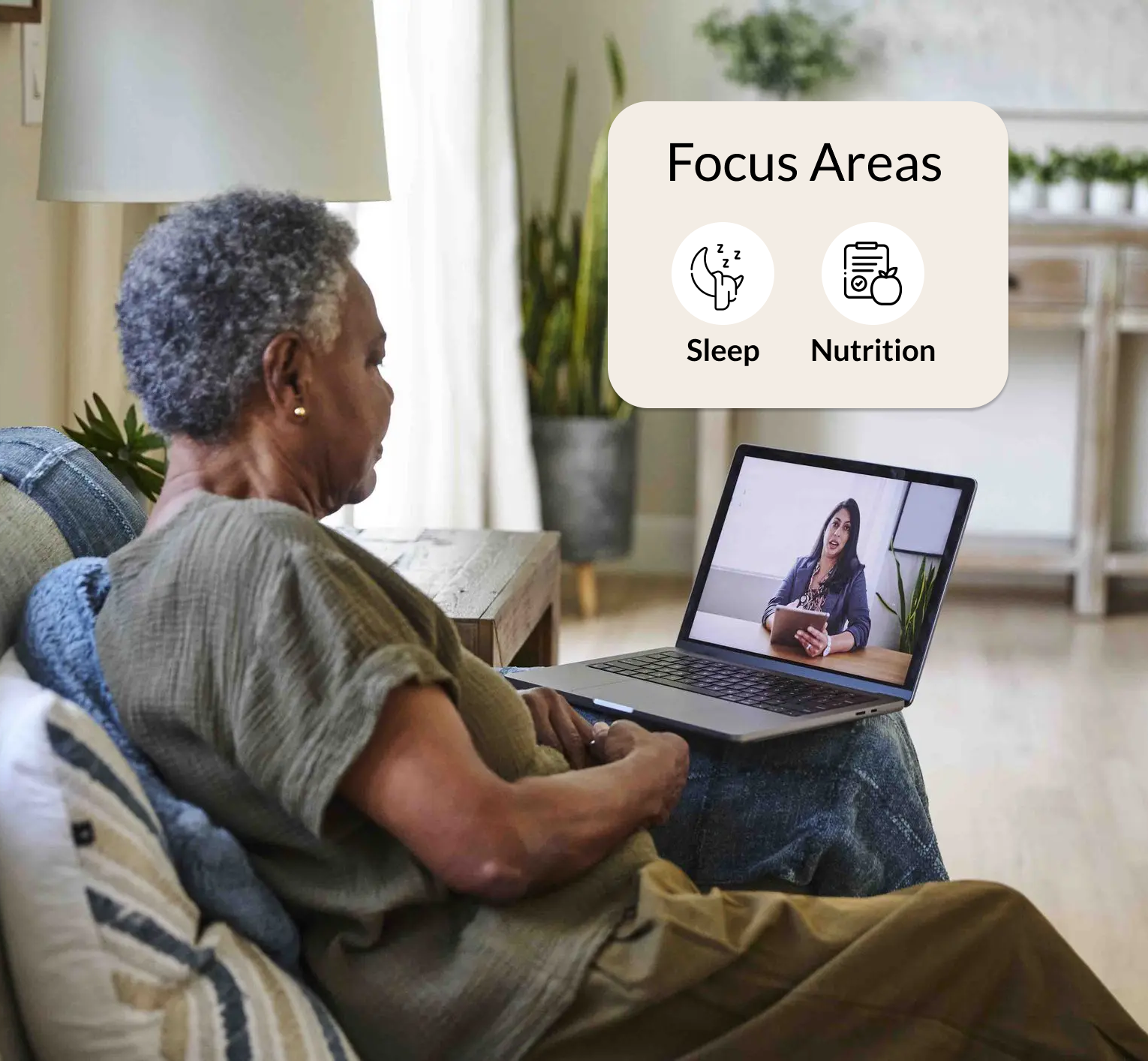
Those are really clinically oriented, and then between those appointments, we try to structure check-ins around those modifiable risk factors. So we have programs for sleep, for nutrition, for physical activity, and for socialization. We can help you establish goals, stay accountable to those goals, and then measure your progress through these more frequent types of check-ins.
That is our Compass program. It's designed to really support our patients and stick with them for the long term, so that they can drive some of these changes, and also stay in close contact with their care team, and incorporate other therapeutics like some of the drugs Dr. Sanders was mentioning. Because, again, we are treating the whole person. And we're approaching this from the 14 modifiable risk factors, but also from all the great new research that's happening and the breakthroughs around some of those medications and therapies.
Why Consider Cognitive Testing
Dr. Amy Sanders: Just as a way of summary, why should any or all of you consider presenting yourselves for cognitive testing?
Not everybody who comes to see a clinician at Sunday Health for an initial visit is going to need the kind of in-depth cognitive testing that I have described. But for those who do have it, it helps to establish a floor, a baseline, against which future comparisons can be made. To use geek speak, you become your own control. In other words, I can test somebody in 2026, and then have them come back again in 2028, and we'll do the same tests, and we'll see how things have changed. For some people, things will get worse over time. It's also possible, though, that things will get better over time. That's maybe less common, but it absolutely, positively happens.
Also, if you come to us for testing, remember I said we're going to get up close and personal in all of your business. We're going to be asking you about all of these modifiable risk factors and the medications that you take and your family history, and we will help you understand how all of that information in aggregate impacts your cognitive state on the day that you get tested, and what we think is likely to happen in the future.
And we will identify areas where you can be your own best treater. If you haven't had your hearing tested, you can go out and get your hearing tested, and if it's found that you need hearing aids, wear those hearing aids every day, and you will have taken dramatic, concrete steps to help your own brain.
It will give you a chance to take early action. You might not be aware that your sleep is doing you harm until you come see us, and when we discuss it, you may have a revelation. And it's not necessarily about sleep, it could be about all sorts of different things.
We like to think of it also as giving you the right care at the right time. If you get a diagnosis of mild cognitive impairment, for example, we are not going to prescribe medications. But we're going to have a long talk with you about ways that you can change your life and change your habits in order to shore up your own cognition. That's one reason that we have this Compass coaching program, because changing one habit is hard enough. If you have to change more than one habit, you really need some external help.
And then for people who do have evidence of frank cognitive decline, even if they have a degree of dementia, this will allow us to figure out where your strengths lie, and allow you, in conjunction with your loved ones, to plan ahead in order to maximize your own independence and safety going forward for the foreseeable future.
From prevention, to pharmacologic care if you need it, to help for your loved ones, Sunday Health is there for you.
Q&A: The Earliest Changes Families Overlook
Ben Hall: Thank you, Dr. Sanders. We're pretty good on time in terms of leaving some space for questions. One question is, what are the earliest changes that families often overlook?
Dr. Amy Sanders: Oh, boy. That depends. Everybody's experience of their own cognition is unique to that person. There are certain things that happen commonly, but there is no defined order that every single person will have.
So sometimes it's, "Gee, I don't understand why my spouse is so much more irritable than he or she used to be." Or, "Why does my spouse not sleep through the night anymore?" Or, "Gosh, my spouse just started this new medication about six weeks ago, and now I'm noticing all this weirdness."
It's not so much that there is a given earliest warning sign. It's being attuned to change from what is usual. And if you see change that concerns you, this is one of those situations where there's no such thing as a bad question. Come see us, and we can help you evaluate whether there's actually cause for concern or not. Sometimes there is, and sometimes there isn't.
Q&A: Telling ADHD Apart From Cognitive Change
Ben Hall: This question probably goes along with that, and I can relate to this one. How can you tell the difference between a pre-existing condition that impacts cognition, like ADHD, and what might be either aging-related cognitive decline or something else?
Dr. Amy Sanders: Remember, when we opened the webinar, one of the first things that we talked about was what happens as part of normal cognitive aging, and that can apply to anybody.
ADHD is a particular character in this whole story. Even though many people think of something that they would call adult-onset ADHD, in fact there is no such thing as adult-onset ADHD. ADHD always has childhood onset. So the key thing here is, is there change from what we would call the baseline? If your ADHD behaved a certain way when you were in your 40s, is it still behaving the same way now that you are in your 70s? Or are you beginning to exhibit changes in your thinking that go beyond your particular ADHD paradigm?
ADHD is not a diagnosis that I make when I do cognitive testing. It's not my expertise. But if somebody comes to me with ADHD, I'm going to ask them many questions about how the ADHD has impacted them over the course of their cognitive lives, and whether they are noticing changes, and whether their loved ones are noticing changes.
Many times, the person who is experiencing the cognitive change is the last to know. They don't recognize it, they're not aware of it. It's loved ones, it's neighbors, it's acquaintances, it's kids, a spouse perhaps, who will notice these changes.
So anything that seems to be moving and not stable is worth coming in and getting evaluated. And if somebody has baseline ADHD, we will do that in a slightly different way than we would for somebody who does not have that baseline contributor.
Q&A: Brain Fog, Stress, and Stage of Life
Ben Hall: Similarly, how would you know the difference between normal brain fog related to aging, like perimenopause, or something related to stage of life, and something unplanned, like the loss of a loved one?
Dr. Amy Sanders: There are certain conditions where brain fog is one of the things that typically occurs. I'm thinking here in particular of fibromyalgia, or what used to be called chronic fatigue syndrome and now has a much more medicalized and polysyllabic name.
But stress and lack of sleep are all things that absolutely can mess with the clarity of your thinking. I will reason by way of a quick anecdote from my own life here.
In April of 2020, when the pandemic was beginning, I was going to work every day. I was not working from home at that time, I had a different job, and since I was going out into the world, I was already exposed, so I was the one who did all the food shopping for my household. It was a Friday, and I went to the supermarket, and I figured, okay, we're not going to have a lot of energy over the weekend, I'm going to get stuff for sandwiches. So I got cold cuts, and I got the sweet pickles, and I got the mustard, and I got ham, and, oops, no bread. Hard to make sandwiches without bread. And I thought, oh, isn't that funny? I must be stressed. And then the following week, I did the exact same thing.
People were coming to see me at that time saying, "I must be losing my mind, I must be developing dementia, because I can't concentrate, I can't do anything." That is how stress affects you.
So, as I've said multiple times, and I promise I will prove this to you if you come see me, we will always take an in-depth look at you in the context of your life, looking for things that are changing that maybe shouldn't be changing. There are lots and lots of things that can appear to have a bad impact on your cognition, and they are not all related to cognitive decline and dementia.
Q&A: Clinical Trials and the Quality of Education
Ben Hall: Two other questions that came in. One was asking if we're familiar with the TRAILBLAZER study, and whether that's something you're able to talk about. And then the other question was, just to clarify, when we talk about quality of education, are we referring to the length of time someone was in school, or whether it's formal or informal education?
Dr. Amy Sanders: I don't think that we have enough time left to go down the TRAILBLAZER rabbit hole at the moment, but I will say that TRAILBLAZER was one of the pivotal clinical trials that led to the approval of one of the new disease-modifying medications. And maybe at some point we could actually host a webinar that talks about clinical trials. What are they? How do you find out about them? How do they get used? And does a study like TRAILBLAZER really matter? The short answer to that last question is yes, absolutely.
On education: one of my favorite tidbits of research in cognitive decline and dementia is that not all education is created equal. Years of education very commonly was used as a proxy for indicating whether we think somebody has good or high educational attainment. It turns out that it's not just years of education, it's the quality of the education.
If somebody grew up in the poor, rural South in the 1940s, their education was probably not as good as that of people who went to private schools in New England during the same time period.
So we will always ask you, how far did you go in school? But we will also ask you, did you have any problems in school? We might ask you what subject you were best in, and we will also ask you what kind of work you did. There, we're sneakily trying to figure out, did you have a job that required you to engage your brain on a daily basis?
So education is important, but it's not as monolithic as we once thought it was.
Q&A: Who Needs In-Depth Testing
Ben Hall: Can you elaborate on cognitive testing? Do we go through that full battery with everyone that we talk to at Sunday Health, or do you make clinical judgments about when a simple assessment is appropriate versus something more in-depth?
Dr. Amy Sanders: We use a screening and diagnostic one-two-punch paradigm. Everybody who comes to have a cognitive evaluation at Sunday Health is going to have some kind of screening assessment. And if they don't do well on that screening assessment, we do not make a diagnosis at that point, because that's completely inappropriate.
It's done all the time, unfortunately. Not at Sunday Health, but in many practices, because doing the kind of investigations that really establish a diagnosis is very time-consuming, and most practices don't have that time. Most practices don't have people with the necessary skills. So, unfortunately, diagnoses are frequently made on the basis of a screening test. I would contend that that should never happen, although I will grant that sometimes, if everything really seems consistent with, say, Alzheimer's disease, then perhaps it's not necessary to make somebody go through all of the steps of the diagnostic evaluation.
But the diagnostic evaluation, in my opinion, is important because it maps the landscape of a person's cognition. We can see where the strengths lie and where the weaknesses lie, and sometimes we can use those strengths to help improve the weaknesses.
So: screening, always. Some people then will be referred on for more in-depth cognitive testing. And sometimes people will need to have that in-depth cognitive testing more than once. If somebody gets a diagnosis of mild cognitive impairment from me, I want to see them at least on an annual basis. A peek behind the curtain here: under the vast majority of circumstances, I don't want people to come back earlier than a year, because quite frankly, I want that person to forget the nature of the cognitive tests that we went through as much as possible. And for most people, about a year will be sufficient for them not to have super good recollection of what I made them do a year ago.
Q&A: Is It Ever Too Late?
Ben Hall: One other question. Everything we talked about tonight, was that about preventing dementia, or can you actually prevent the decline of dementia, or MCI, if you already have it, through some of those modifiable risk factors and medications?
Dr. Amy Sanders: It is never too late to become proactive and address your own modifiable risk factors. Even if one has a diagnosis of dementia, if you optimize everything that is optimizable, and I use that expression a lot, and it's what I see myself as helping my patients to do, you can slow down the rate of your own cognitive decline.
We refer to this sometimes as flattening the slope. Rapid cognitive decline might look like a steep line, but if you fix your risk factors, if you start using the CPAP that you need for your sleep apnea, if you start wearing your hearing aids, if you quit eating only fast food, then your line might become much shallower.
It is never too late to take healthy, proactive, brain-protective steps.
Closing
Ben Hall: This was super. Really appreciate you answering some of those questions, and I know we didn't get to all of them, so we can try to address those in follow-up webinars we might do. I liked your idea about the one on clinical trials, so we can think about scheduling one of those.
Thank you to everyone for joining. We'll send out the presentation, and you should be able to get a copy and a recording of the presentation this evening. If you have trouble finding that, just reach out to us and we're happy to send that along.
Really appreciate it, everyone. Hope everyone has a good evening.
Dr. Amy Sanders: Likewise.